Altcoin News
Altcoin Rotation Phase Explained Market Shift From Bitcoin To Altcoins

Introduction
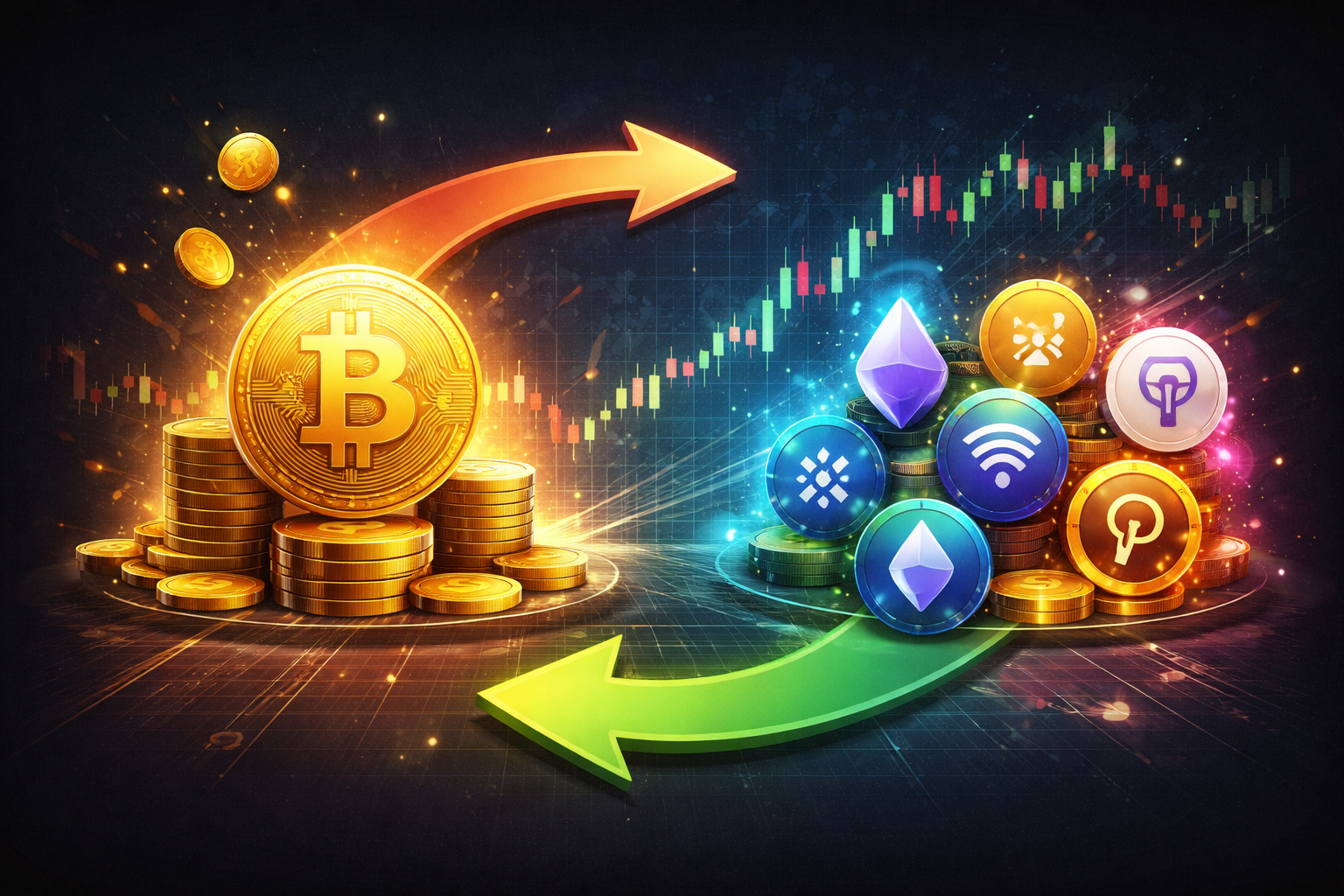
The cryptocurrency market has entered a fascinating transitional phase where momentum appears to be gradually shifting away from Bitcoin and toward altcoins. After a prolonged period of Bitcoin dominance, recent market behavior indicates that altcoins are beginning to reclaim attention, liquidity, and trading volume. This shift is not sudden or random. Instead, it reflects a deeper structural evolution within the crypto market, driven by investor psychology, macroeconomic conditions, technological developments, and cyclical capital flows.
For years, Bitcoin has served as the primary gateway for capital entering the cryptocurrency ecosystem. Its dominance has often dictated broader market sentiment. However, when Bitcoin reaches a point of consolidation or resistance, as seen recently near the seventy thousand level, the market tends to undergo a redistribution of capital. This redistribution is what analysts commonly describe as an altcoin rotation phase.
Understanding The Concept Of Market Structure
Market structure in cryptocurrency refers to the way capital flows between different assets over time. It includes patterns such as accumulation, breakout, consolidation, and distribution. These phases are not limited to Bitcoin alone but extend across the entire crypto ecosystem.
In a typical cycle, Bitcoin leads the market during the early stages of a bull run. Investors view it as the safest and most established digital asset, which makes it the first recipient of large inflows. Once Bitcoin experiences significant gains and begins to stabilize, investors start looking for higher returns elsewhere. This is when altcoins begin to gain traction.
The current market environment reflects this exact transition. Bitcoin’s inability to decisively break above a major psychological resistance level has created conditions for capital to rotate into alternative assets. As a result, altcoins have started outperforming Bitcoin in terms of percentage gains, signaling a shift in market structure.
Bitcoin Stalling Below Seventy Thousand
Bitcoin’s recent price action has played a crucial role in triggering the shift toward altcoins. After a strong upward movement, Bitcoin approached the seventy thousand mark but failed to sustain momentum above this level. This kind of price behavior is often interpreted as a sign of temporary exhaustion.
When Bitcoin stalls, it does not necessarily indicate weakness in the broader market. Instead, it often signals a period of consolidation where traders reassess their positions. During this phase, volatility in Bitcoin decreases, and traders begin reallocating capital into assets with higher growth potential.
This stalling effect creates a psychological shift among investors. Instead of expecting immediate gains from Bitcoin, they begin exploring altcoins that have not yet experienced significant price appreciation. This change in sentiment is one of the key drivers behind the increase in altcoin trading volume.
Rise In Altcoin Trading Volume Share
One of the most telling indicators of an altcoin rotation phase is the increase in altcoin trading volume relative to Bitcoin. Trading volume represents the level of activity and interest in a particular asset. When altcoins begin to capture a larger share of total market volume, it suggests that traders are actively shifting their focus.
Recent data shows that altcoin trading volume has risen noticeably after a period dominated by Bitcoin. This increase is not limited to a single category of altcoins but spans across multiple sectors, including decentralized finance, layer two scaling solutions, gaming tokens, and artificial intelligence related projects.
The rise in volume is significant because it reflects real participation rather than speculative hype alone. It indicates that both retail and institutional investors are diversifying their portfolios and seeking opportunities beyond Bitcoin. This diversification contributes to a broader and more dynamic market environment.
Altcoins As The Main Drivers Of Gains
Another defining feature of the current market phase is that altcoins have become the primary drivers of gains. While Bitcoin remains relatively stable, many altcoins have posted double digit percentage increases within short timeframes.
This phenomenon is not unusual in crypto cycles. Altcoins are inherently more volatile than Bitcoin, which means they can generate higher returns during favorable market conditions. When liquidity flows into altcoins, it often leads to rapid price movements that outperform Bitcoin on a relative basis.
The performance of altcoins during this phase is driven by several factors. Technological upgrades, ecosystem expansions, and new use cases all contribute to increased demand. Additionally, speculative interest plays a role as traders attempt to capitalize on short term price movements.
As altcoins begin to lead the market, they create a feedback loop. Rising prices attract more attention, which in turn brings in more capital, further accelerating the upward momentum. This cycle can continue until the market reaches a point of saturation or experiences a broader correction.
Early Stage Altcoin Rotation Phase
The current market conditions strongly suggest that the crypto ecosystem is in the early stages of an altcoin rotation phase. This phase is characterized by a gradual but consistent shift in capital from Bitcoin to altcoins.
In the early stage, only a select group of altcoins begin to outperform. These are usually projects with strong fundamentals, active development, and clear narratives. As the phase progresses, the rally tends to expand to a wider range of altcoins, including mid cap and small cap tokens.
Recognizing the early stage of this rotation is crucial for market participants. It provides an opportunity to identify emerging trends and position accordingly. However, it also requires careful analysis, as not all altcoins will benefit equally from the rotation.
Role Of Investor Psychology
Investor psychology plays a central role in driving the altcoin rotation phase. Markets are not driven purely by fundamentals but also by perception, sentiment, and expectations.
When Bitcoin dominates the market, it creates a sense of stability and confidence. However, once it begins to consolidate, investors start seeking higher returns. This shift in mindset leads to increased risk appetite, which favors altcoins.
Fear of missing out is another important factor. As traders observe altcoins delivering significant gains, they are more likely to enter the market, further fueling the rally. This behavior amplifies price movements and contributes to the rapid expansion of altcoin activity.
At the same time, caution remains present. Experienced investors understand that altcoin rallies can be volatile and short lived. This balance between optimism and caution defines the dynamics of the current phase.
Impact Of Technological Developments
Technological advancements within the crypto space have also contributed to the shift toward altcoins. Many altcoin projects are focused on solving specific problems, such as scalability, privacy, and interoperability.
As these projects introduce new features and improvements, they attract attention from developers, investors, and users. This increased interest translates into higher demand for their tokens, which supports price growth.
The expansion of decentralized applications, smart contract platforms, and blockchain infrastructure has created a diverse ecosystem where altcoins play a crucial role. Unlike earlier cycles, where speculation dominated, the current phase is supported by tangible developments and real world use cases.
Macro Factors Influencing The Shift
Global economic conditions also influence the behavior of cryptocurrency markets. Factors such as interest rates, inflation, and liquidity conditions affect investor decisions across all asset classes.
In periods of increased liquidity and positive risk sentiment, investors are more willing to allocate capital to higher risk assets, including altcoins. Conversely, uncertainty and tightening financial conditions can limit the sustainability of altcoin rallies.
The current environment appears to support a moderate level of risk taking, which aligns with the observed increase in altcoin activity. However, external factors remain unpredictable, and any significant changes could impact the trajectory of the market.
Risks Associated With Altcoin Rotation
While the altcoin rotation phase presents opportunities, it also carries significant risks. Altcoins are generally more volatile than Bitcoin, which means they are more susceptible to sharp price corrections.
Not all projects have strong fundamentals, and some may experience rapid declines after initial gains. This makes it essential for investors to conduct thorough research and avoid chasing hype driven movements.
Liquidity is another concern. Smaller altcoins may have limited trading volume, which can lead to increased price manipulation and sudden fluctuations. Understanding these risks is crucial for navigating the market effectively.
Future Outlook For Altcoins
The outlook for altcoins depends on several factors, including Bitcoin’s price behavior, overall market sentiment, and ongoing developments within the crypto ecosystem.
If Bitcoin continues to consolidate, the altcoin rotation phase could gain further momentum. This would likely result in broader participation across different sectors and increased innovation within the space.
However, if Bitcoin resumes a strong upward trend, it could temporarily regain dominance and draw capital away from altcoins. This dynamic interplay between Bitcoin and altcoins is a defining characteristic of the crypto market.
Conclusion
The recent increase in altcoin trading volume and performance marks a significant shift in the cryptocurrency market structure. With Bitcoin stalling below a key resistance level, capital has begun to flow into altcoins, creating an environment where alternative assets are driving market gains.
This early stage altcoin rotation phase reflects a combination of technical factors, investor psychology, technological advancements, and macroeconomic influences. While it presents opportunities for growth, it also requires careful navigation due to the inherent risks associated with altcoins.